
When Do You Need a Business Valuation? 7 Critical Moments Every Founder Must Know
Discover the 7 key situations when a business valuation is essential — from fundraising and M&A to ESOP planning, 409A compliance, exit strategy, and strategic growth.
Key Takeaways
- check_circleBusiness valuation is required at 7 critical moments: fundraising, M&A, ESOP planning, regulatory compliance, strategic decisions, loan approvals, and exit planning.
- check_circleA 409A valuation is a legal requirement before issuing stock options — options priced below fair market value trigger a 20% penalty tax for employees.
- check_circleSellers without a professional valuation routinely leave money on the table during exit negotiations.
- check_circleThe five core valuation drivers are revenue quality, growth rate, market size, risk factors, and financial documentation.
- check_circleGetting valued too late — in the middle of a deal — leads to rushed analysis, weak reports, and poor outcomes.
Introduction
Every business decision you make is shaped by what you believe your company is worth. If that number is wrong — or worse, a guess — you're making critical choices with bad data.
Most founders assume valuation is something you deal with when you're ready to sell. In reality, there are at least seven inflection points in a company's life where an accurate, defensible valuation isn't just useful — it's essential. This guide walks you through each one, explains why it matters, and helps you avoid the costly mistakes that come from flying blind.
What Is Business Valuation, Exactly?
Business valuation is the process of determining the economic worth of your company at a specific point in time. It's not a single number pulled out of thin air — it's a structured analysis that considers your financial performance, market conditions, industry benchmarks, and future growth trajectory.
| Methodology | Description |
|---|---|
| Discounted Cash Flow (DCF) | Projects your future earnings and discounts them back to present value |
| Market Approach | Compares your company to similar businesses that have been valued or sold recently |
| Asset-Based Approach | Calculates the net value of your tangible and intangible assets |
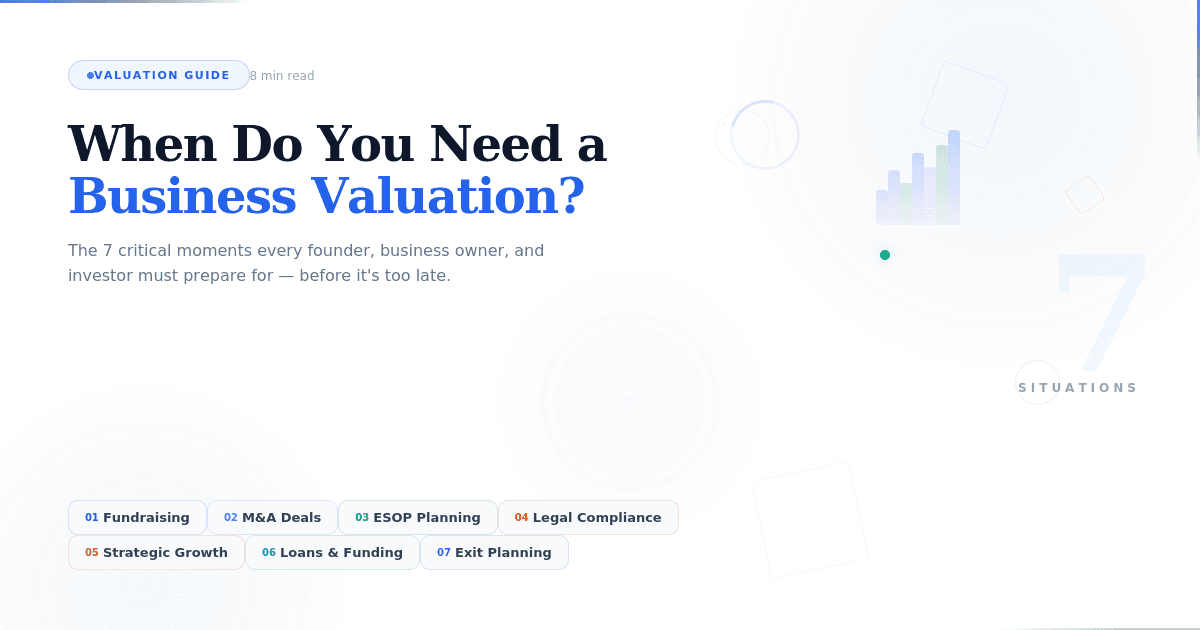
7 Situations Where You Need a Business Valuation
1. Fundraising and Investor Discussions
Before any investor writes a check, they need to understand what they're buying into. The first question in every pitch meeting is: What's your valuation? If you don't have a credible answer backed by methodology and data, you're either going to give away too much equity or lose the deal entirely.
A proper pre-money valuation means you raise more capital with less dilution. A 409A valuation means your equity grants are legally compliant.
2. Mergers, Acquisitions & Business Deals
Whether you're selling your company, acquiring a competitor, or merging with a complementary business, valuation is the foundation of every negotiation. Sellers without a valuation anchor on emotional numbers. Buyers without independent data risk overpaying.
Key factors evaluated in M&A valuation:
- Revenue multiples
- EBITDA
- Growth rates
- Customer concentration risk
- Intellectual property
A well-structured valuation report gives both sides a common frame of reference and eliminates information asymmetry that leads to bad deals.
3. ESOP and Employee Equity Planning
If you're offering shares or stock options to your team, you need to know what those shares are actually worth. This isn't just good practice — it's a regulatory requirement in most jurisdictions.
- Setting the share price too high makes equity unattractive to employees
- Setting it too low creates tax liabilities and compliance risks
A well-structured equity plan backed by defensible valuation is one of the most powerful retention tools available — especially when you can't match the cash compensation of larger competitors.
4. Legal and Regulatory Compliance
In many jurisdictions, valuation isn't optional — it's mandatory.
| Jurisdiction | Requirement |
|---|---|
| India | Share issuance under Companies Act 2013, FEMA foreign investment transactions, Income Tax Act compliance |
| United States | Section 409A (equity compensation), ASC 820 (fair value measurement for financial reporting) |
5. Strategic Decision-Making and Growth Planning
Valuation isn't just something you do for external stakeholders. It's one of the most powerful internal tools available to a leadership team. A thorough valuation reveals which parts of your business are actually creating value and which are dragging it down.
- Revenue is growing — but is it profitable revenue?
- You're expanding into new markets — but at what cost to your core business?
Think of valuation as a diagnostic report for your business — answering critical questions with data, not intuition.
6. Loans, Funding & Financial Approvals
Banks and financial institutions require valuation reports to assess creditworthiness, evaluate collateral, and determine loan terms. This applies whether you're seeking a term loan, a line of credit, or any form of structured financing.
A strong, well-documented valuation doesn't just improve your chances of approval — it can directly influence the terms you receive, including favorable interest rates and higher credit limits.
7. Exit Planning and Business Sale
If you're planning to exit — whether through a full sale, partial buyout, or management transition — the biggest financial mistake you can make is entering negotiations without knowing your company's true value. Sellers who rely on rules of thumb or back-of-the-napkin multiples routinely leave money on the table.
- Identifies and quantifies every source of value — from recurring revenue to customer relationships to intellectual property
- Helps identify improvements before going to market
- Targeted improvements to financial documentation, customer concentration, or operational processes can meaningfully increase exit price
A professional valuation ensures you capture the full value of what you've built and identifies pre-sale improvements that increase your exit price.
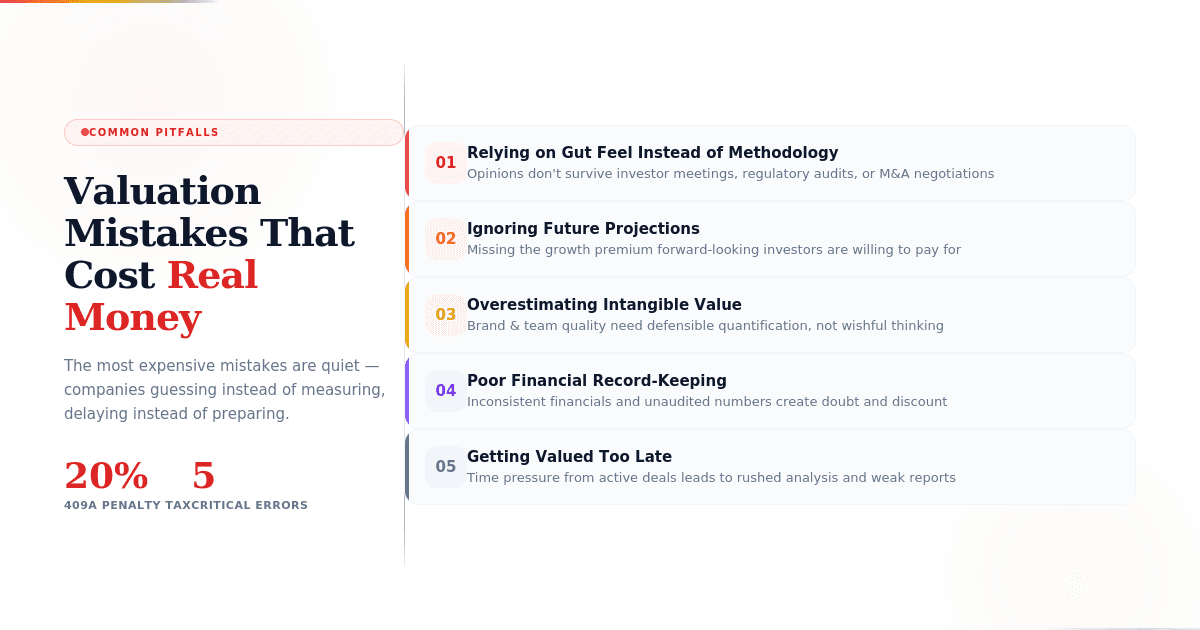
Common Valuation Mistakes That Cost Real Money
The most expensive valuation mistakes aren't dramatic — they're quiet. They happen when companies guess instead of measure, delay instead of prepare, or cut corners on methodology.
| Mistake | Impact |
|---|---|
| Relying on gut feel instead of methodology | A number without DCF, market comparables, or asset valuation is just an opinion — it won't hold up in investor meetings, audits, or M&A negotiations |
| Ignoring future projections | Valuations focused only on historical financials miss the growth premium investors and buyers are willing to pay |
| Overestimating intangible value | Brand and team quality contribute to value — but they need defensible quantification, not wishful thinking |
| Poor financial record-keeping | Inconsistent financials and missing documentation create doubt with investors, acquirers, and regulators |
| Getting valued too late | Waiting until mid-deal creates time pressure that leads to rushed analysis and weak reports |
How Often Should You Get a Valuation?
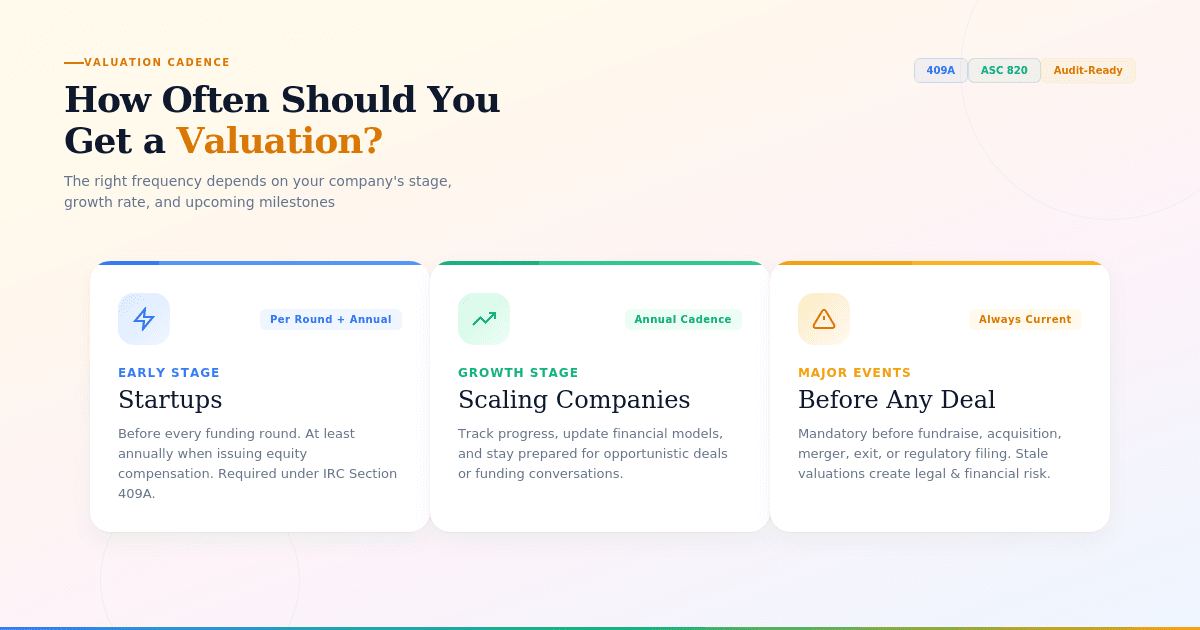
| Company Type | Recommendation |
|---|---|
| Startups | Before every funding round and at least annually if issuing equity compensation — required under 409A |
| Growing Businesses | Annual valuations to track progress, update financial models, and stay prepared for opportunistic deals |
| Before Major Events | Always mandatory before a fundraise, acquisition, merger, exit, or significant regulatory filing |
What Actually Drives Your Valuation?
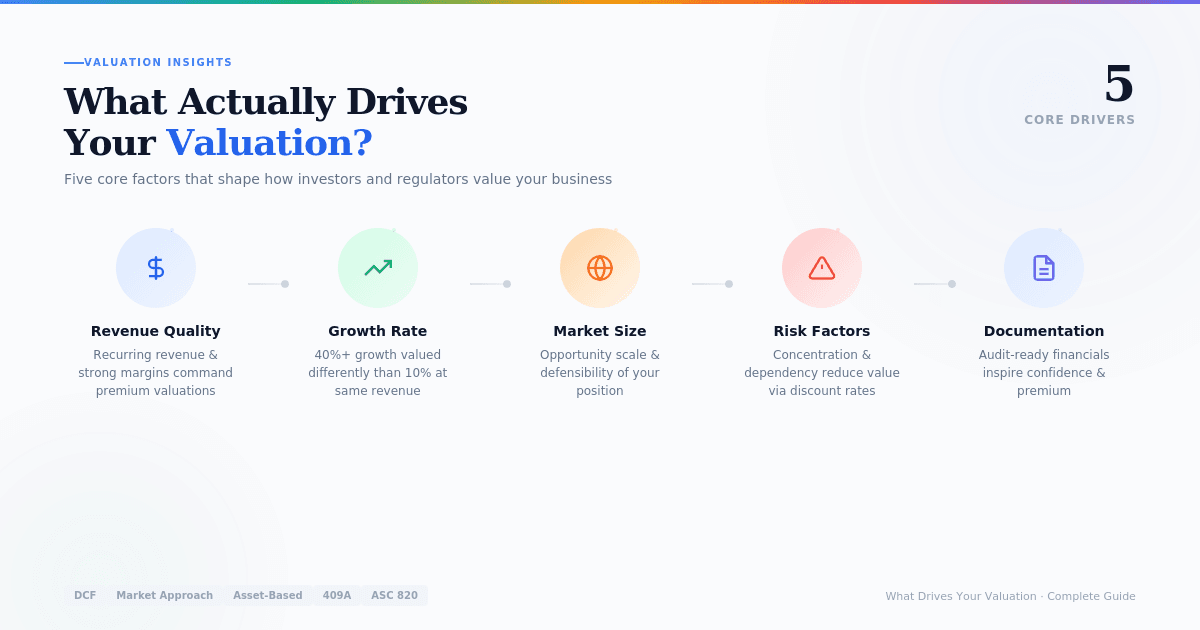
While specific factors vary by methodology and industry, most valuations are shaped by five core drivers:
| Driver | Why It Matters |
|---|---|
| Revenue Quality and Profitability | Recurring revenue, strong margins, and predictable cash flows command premium valuations |
| Growth Rate and Trajectory | Companies growing at 40%+ annually are valued very differently than those growing at 10% |
| Market Size and Competitive Position | Determines how large the opportunity is and how defensible your market share is |
| Risk Factors | Customer concentration, regulatory exposure, and key-person dependency reduce valuation through higher discount rates |
| Financial Documentation and Governance | Well-documented, audit-ready financials inspire confidence; messy books create doubt and discount |
Conclusion
Business valuation isn't a one-time event you schedule when you're ready to sell. It's a recurring discipline that informs every major financial decision your company makes — from raising capital to granting equity to planning an exit.
The companies that treat valuation as a strategic practice rather than a compliance checkbox consistently make better decisions, negotiate better deals, and build more valuable businesses over time.
Frequently Asked Questions
When do you need a business valuation?expand_more
You need a business valuation during seven key moments: fundraising and investor discussions, mergers and acquisitions, ESOP and employee equity planning, legal and regulatory compliance (including 409A and ASC 820), strategic decision-making, loan and funding approvals, and exit planning or business sale.
What is business valuation and how does it work?expand_more
Business valuation is the process of determining the economic worth of a company at a specific point in time. It uses structured methodologies including Discounted Cash Flow (DCF), Market Approach (comparing with similar businesses), and Asset-Based Approach (calculating net tangible and intangible assets). The right method depends on the company's stage, industry, and valuation purpose.
Why is a 409A valuation required before issuing stock options?expand_more
In the US, IRC Section 409A requires an independent valuation of common stock before a private company grants equity compensation. Issuing stock options below fair market value can trigger a 20% penalty tax for employees. A 409A valuation ensures equity grants are legally compliant and protects both the company and its employees.
How often should a company get a business valuation?expand_more
Startups should get a fresh valuation before every funding round and at least annually if issuing equity compensation (required under 409A). Growing businesses benefit from annual valuations to track progress and stay deal-ready. A current valuation is mandatory before any major event such as a fundraise, acquisition, merger, exit, or regulatory filing.
What are the most common business valuation mistakes?expand_more
The most costly valuation mistakes include relying on gut feel instead of established methodology, ignoring future projections and growth premium, overestimating intangible value without defensible quantification, poor financial record-keeping, and getting valued too late — waiting until you are in the middle of a fundraise or deal negotiation leads to rushed analysis and weak reports.
What factors drive a company's valuation?expand_more
Five core drivers shape most valuations: revenue quality and profitability (recurring revenue and strong margins command premiums), growth rate and trajectory, market size and competitive position, risk factors (customer concentration, regulatory exposure, key-person dependency), and financial documentation and governance quality.