
Understanding Cap Table Management: Why It Matters for Growing Companies
Cap tables are the foundation of ownership, valuation, and investor trust. Learn why accurate cap table management is critical and how modern platforms simplify the process.
Key Takeaways
- check_circleA cap table tracks all shareholders, securities, funding rounds, ESOPs, and dividend rights in one dynamic view.
- check_circleInaccurate cap tables lead to incorrect valuations, mispriced stock options, and loss of investor confidence.
- check_circleManual spreadsheet-based management becomes error-prone as companies scale through multiple funding rounds.
- check_circleCap tables are essential inputs for valuation models like FMV and 409A — any change in one directly impacts the other.
- check_circleModern platforms automate calculations, provide real-time tracking, and enable scenario modeling for dilution analysis.
Introduction
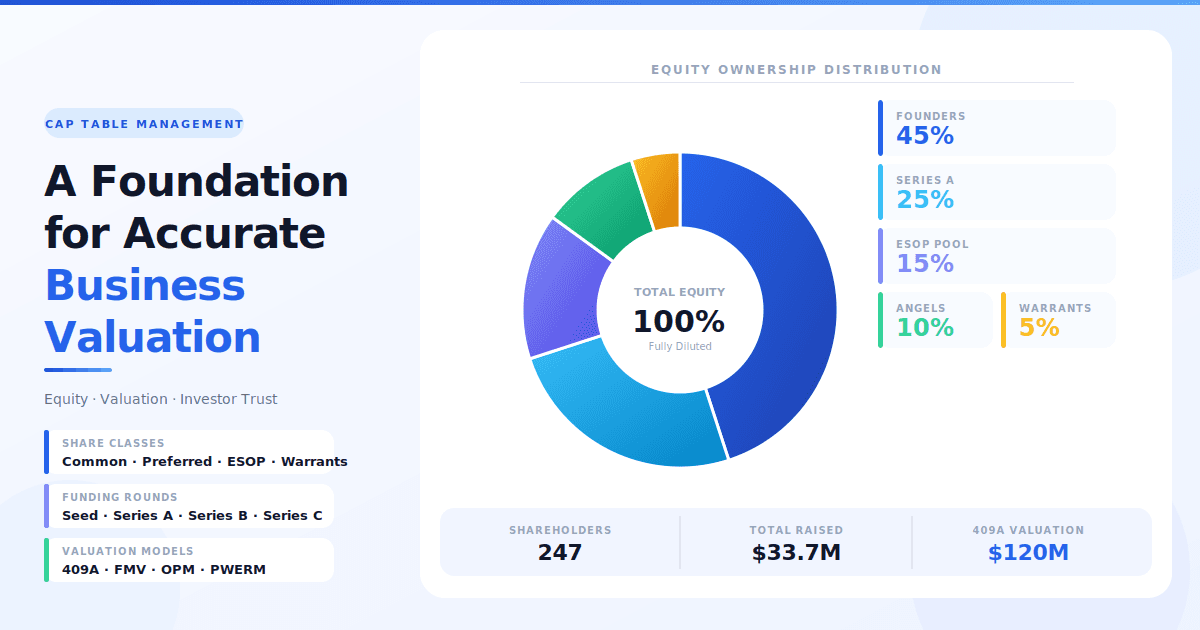
In today's startup ecosystem, managing equity is no longer a simple task. As companies grow, raise funding, and issue employee stock options, ownership structures become increasingly complex. This is where cap table (capitalization table) management becomes critical. A cap table is not just a list of shareholders — it is the foundation of a company's ownership, valuation, and investor trust.
The Growing Complexity of Cap Tables
In the early stages, a cap table may include only founders and a few investors. However, as the company scales, multiple funding rounds, ESOP allocations, convertible instruments, and secondary transactions add layers of complexity. Without a proper system, companies often rely on spreadsheets, which can quickly become difficult to manage.
What Does a Cap Table Track?
A well-structured cap table captures all aspects of a company's equity:
- Shareholders and ownership percentages
- Different types of securities such as common shares, preferred shares, options, and warrants
- Funding rounds and investment details
- ESOP allocations and vesting schedules
- Dividend rights and liquidation preferences
This makes the cap table a complete and dynamic view of a company's ownership structure.
Why Accuracy Matters
Cap tables directly impact business valuation. Every share, security type, and ownership percentage influences how a company's value is calculated. Inaccurate cap tables can result in:
- Incorrect valuation outputs
- Mispriced employee stock options
- Delays during due diligence
- Loss of investor confidence
Maintaining a clean and accurate cap table is essential for smooth fundraising and strategic decision-making.
Challenges with Manual Cap Table Management
Managing cap tables manually presents several challenges:
- Frequent updates after each funding round
- Handling multiple share classes and complex terms
- Accurate dilution and ownership calculations
- Maintaining error-free records
Spreadsheets often lack validation, making them prone to mistakes, especially as the company grows.
A Structured Approach to Cap Table Management
Modern platforms introduce a structured workflow for cap table management, ensuring accuracy and consistency:
- Defining all securities and share classes
- Configuring share class terms such as conversion and preferences
- Setting dividend and participation rules
- Recording investments and share allocations
- Managing ESOPs and warrants
- Validating the entire cap table before finalization
Role in Valuation
Cap tables play a central role in valuation models such as Fair Market Value (FMV) and 409A valuations. They provide the necessary inputs, including share classes, rights, and ownership structure.
Valuation and cap tables are interconnected — any change in one directly impacts the other. This makes accurate cap table management essential for reliable valuation outcomes.
How Technology Improves Cap Table Management
Modern platforms simplify cap table management by offering:
- Automated calculations and validation
- Real-time ownership tracking
- Scenario modeling for funding and dilution
- Easy management of investors and employee equity
- Secure and role-based access control
These features help companies move away from manual errors and focus on growth.
Conclusion
Cap table management is a critical part of building a successful company. It ensures transparency, supports accurate valuation, and strengthens investor confidence. As businesses grow and ownership structures become more complex, relying on spreadsheets is no longer sufficient.
Adopting a modern, structured platform enables companies to manage their equity efficiently and make informed decisions. Our platform simplifies cap table management by combining automation, real-time tracking, and integrated valuation tools — helping businesses manage ownership with clarity and confidence.
Frequently Asked Questions
What is a cap table and what does it track?expand_more
A cap table (capitalization table) is a detailed record of a company's ownership structure. It tracks shareholders and ownership percentages, types of securities (common shares, preferred shares, options, warrants), funding rounds, ESOP allocations, vesting schedules, and dividend rights.
Why is cap table accuracy important for valuation?expand_more
Cap tables directly impact business valuation because every share, security type, and ownership percentage influences how a company's value is calculated. Inaccurate cap tables can lead to incorrect valuation outputs, mispriced employee stock options, delays during due diligence, and loss of investor confidence.
What are the challenges of managing cap tables manually?expand_more
Manual cap table management using spreadsheets presents challenges including frequent updates after each funding round, handling multiple share classes with complex terms, accurate dilution and ownership calculations, and maintaining error-free records. Spreadsheets lack validation, making them prone to mistakes as the company grows.
How do modern platforms improve cap table management?expand_more
Modern platforms simplify cap table management through automated calculations and validation, real-time ownership tracking, scenario modeling for funding and dilution, easy management of investors and employee equity, and secure role-based access control.